All articles
Hotel Operations
Why digitalisation projects in hotels fail – and what successful hotels do differently

Hotels face many challenges. The two biggest are arguably the ongoing shortage of skilled staff and rising guest expectations.
To tackle these, many hotels have invested in new technologies in recent years. Digital check-in solutions, messaging tools, automated payment processes and upselling systems are now standard in the industry. The hopes associated with these are: less manual work, faster processes and a better guest experience.
In practice, however, disillusionment often sets in. Despite all the investment in digital tools, the workload remains high. Staff still have to carry out many processes manually, coordination between different departments remains complicated, and the guest experience improves only marginally.
Here we outline the most common reasons why digitalisation in hotels so often fails. We also demonstrate how automation actually delivers the desired results and why it is a management project, not an IT one.
A look at many hotel operations reveals that there is rarely a shortage of digital tools. On the contrary, there is often a whole range of tools:
Each of these systems fulfils a useful function in its own right. The central problem is the lack of integration:
Guest data is stored in multiple systems and needs to be reconciled.Payment information is not automatically synchronised.The messaging system does not know the guests’ current status.Staff switch between different interfaces to provide comprehensive service to a single guest.
What was intended as a technological advancement often leads to additional complexity in day-to-day operations.
Guests also experience the effects of this complexity: a message does not match the actual status of their stay, an offer appears at the wrong time, and waiting times occur at check-in despite digital preparation.
Every hotel is different, but the reasons why digital transformation in the hospitality industry is often ineffective are mostly the same.
Digitalisation without a clear strategy
Many digitalisation projects in the hotel industry involve introducing a new tool for a specific function, digitally mapping a process, or expanding an existing system.
Processes are not reimagined, but merely mapped digitally. There is a lack of clear objectives and prioritisation. Those responsible choose a tool based on its range of functions, design or references from other hotels. They pay little heed to their own operational reality.
The result: whilst individual sub-processes may be digitised, the workload remains high. A digital check-in does not reduce working hours if staff continue to check data manually, and a messaging tool does not ease the team’s workload if they continue to process enquiries individually.
Too many individual solutions instead of an integrated system
Another common problem is the gradual introduction of specialised individual solutions: one system for check-in, another for communication, a third for payments, and a fourth for upselling.
This results in a system landscape in which each solution has its own logic, its own data structures and its own interfaces.
In operational practice, this leads to several problems:
The more individual solutions are in use, the greater the coordination effort required.
Instead of simplifying processes, a fragmented structure emerges that is difficult to manage and prone to errors.

Processes are digitised – but not improved
Many hotels digitise existing processes without questioning them.
The result then looks something like this:
In the past, guests filled in a form at reception. Today, they do this online in advance. At first glance, this sounds like progress. However, once the form is filled in, the following happens:
The same pattern is evident in many areas:
A request comes via chat rather than by phone, but is still answered manually. An upgrade is booked digitally, but still needs to be approved internally. As long as a process consists of several manual checking and approval steps, it will not automatically become more efficient through the use of a digital tool.
Staff are not sufficiently involved
Managers in the hotel industry tend to decide on digitalisation projects ‘for’ the team, but do not implement them ‘with’ the team. They do not discuss the rollout together in advance, do not seek feedback and, at best, organise superficial training sessions
This often leads to situations such as the following:
A hotel introduces a new system that looks very modern and has an impressive range of functions.
However, staff are left with questions when using it:
Out of uncertainty, staff fall back on familiar procedures and, for example, enter information twice. This increases the workload. What’s more, if a tool makes processes more complicated because it doesn’t fit with existing workflows or employees can’t use it, it won’t be accepted in day-to-day work.
Digitalisation is viewed as an IT project
Hoteliers often hand digitalisation over to the IT department or external service providers.
Their task is to select a system, implement it and set up interfaces.
Technically, this often works well; operationally, not so much.
After all, the crucial questions are really the responsibility of management:
If such questions remain unanswered, the technology remains isolated. This leads to uncertainty, a need for coordination and errors. The tool and practice do not fit together.
When digitalisation projects fail to deliver, it rarely happens abruptly. There is no clear break, but rather a creeping shift in day-to-day operations. Processes appear more modern, but are not simpler. New systems are in place, but do not reduce the workload. Over time**, more and more negative consequences** become apparent:
With every new tool comes another interface, additional logic and a new data flow. Employees must understand which system contains which information and how they are connected.
This complexity almost inevitably leads to data problems. Information exists in multiple places but is inconsistent. Guest data differs between the PMS, CRM and messaging systems. Payment statuses and booking details do not match. Special requests are documented somewhere, but not where they are needed at the crucial moment. New sources of error arise, and the original idea of a clean database is lost.
Guest communication becomes inaccurate. Messages do not match the current status of the stay; offers arrive at the wrong time or are based on incorrect assumptions. To the guest, this appears as a lack of coordination. The expectation is clear: those who communicate digitally should also communicate consistently. If this fails, trust suffers.
At the same time, costs rise. In addition to the obvious licence costs for multiple systems, hidden expenses arise. Processes take longer, even though they are supported by digital- . Peak times are not alleviated, but simply shifted. Instead of a queue at reception, one forms in the inbox or within the system.
The expectation of working more efficiently conflicts with the actual experience in day-to-day operations. Systems are complex to use; information is available but unreliable. Decisions become more difficult, not easier.
At this point, perceptions of digitalisation in the hospitality industry shift. Staff see it as an additional burden rather than a solution. This leads to necessary changes being delayed, even though the real problem is not digitalisation, but a lack of structure.
Start with the guest journey
Successful hotels start by asking how the stay actually unfolds from the guest’s perspective. A look at the entire guest journey reveals where gaps occur, where information is missing and where unnecessary steps take place. This allows them to decide which processes can be simplified or automated.
Clarify processes before technology
Before a new system is introduced, it must be clearly defined what operational changes are required. Which steps are to be eliminated, which tasks will be automated, and what information is available when? The technology only becomes relevant once the target process has been established. This prevents managers from simply digitising existing workflows. Instead, clearer, shorter and more manageable processes are created.
Replace a ‘tool zoo’ with integration
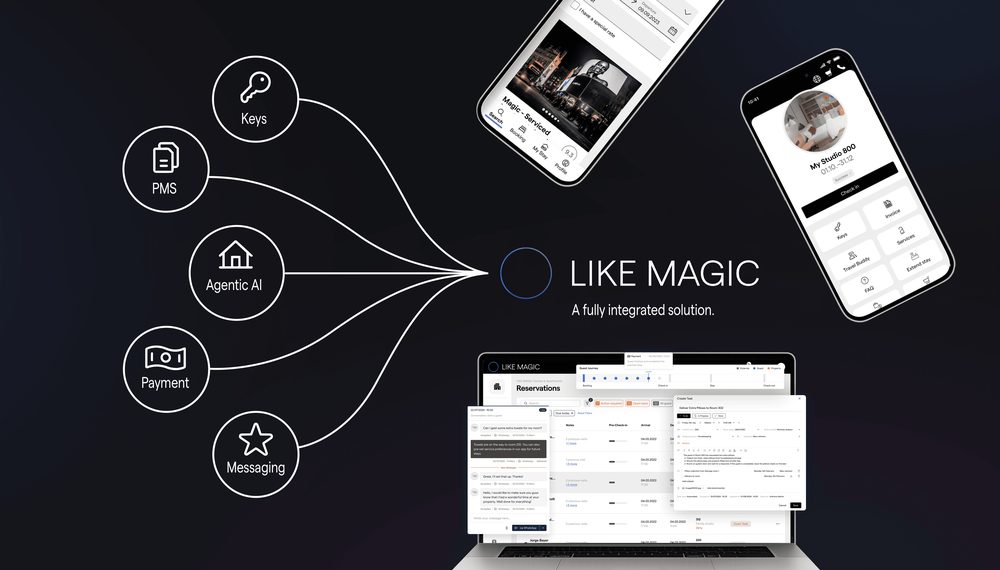
Rather than introducing a new solution for every problem, successful hotels focus on how systems work together. It is crucial that data flows seamlessly between the PMS, communications, payments and operational departments, and that information is available where it is needed, without manual transfer, IT expertise or additional coordination.
Supporting staff rather than replacing them
Digitalization is seen not as a replacement, but as a support for staff. When systems reliably handle standard enquiries, data entry or simple coordination tasks, this frees up time for personal interaction, more complex issues and genuine service quality.
The key difference stems from a different approach to systems. Instead of optimising individual functions, the entire workflow is placed at the centre of the . The question is no longer which system handles which task, but how information and processes interlock seamlessly.
In such a structure, data forms the common foundation. Information is created once and is available wherever it is needed. Payment status, room status or guest data are no longer tied to individual systems, but are consistently available. This eliminates many manual checking and reconciliation steps that take up time in day-to-day operations.
Processes are also changing. Tasks no longer arise between systems but are processed in the background. Statuses update automatically, information is traceable at all times, and workflows interlock. The operational burden shifts away from coordination and control towards clear, stable processes.
For this to work, an overarching structure is required that connects systems and controls workflows. An experience layer fulfils precisely this role. It aggregates data, synchronises information and ensures that interactions remain consistent across all channels. For guests, this creates a seamless experience; for staff, a reliable working foundation.
Digitalisation in the hotel industry fails when it is viewed as a collection of individual measures. Without a clear definition of objectives, without consistent process logic and without integration, no real change takes place. Instead, complexity, coordination efforts and operational uncertainty increase.
Successful hotels take a different approach. Those in charge view digitalisation as part of operational management. They consciously design processes, clarify responsibilities and deploy systems in such a way that they support these workflows. Technology follows the structure, not the other way round.
The key lever lies in reducing friction throughout the entire guest journey through cross-process platforms and experience layers. Only when information is consistently available and workflows interlock do the effects emerge that many hotel operators hope to achieve through digitalisation: less effort, clearer processes and a seamless guest experience.
Digitalisation in the hotel industry describes the transition from manual, paper-based or isolated processes to digital, interconnected workflows. The aim is not merely to digitise individual tasks, but to link information and processes throughout the entire guest journey.
The most common reasons are a lack of strategy, isolated individual solutions and unclear processes. Many hotels introduce new tools without fundamentally rethinking their workflows. This results in additional interfaces, manual intermediate steps and increasing complexity rather than genuine efficiency gains.
A successful digitalisation strategy for hotels does not start with technology, but with processes. It is best for those in charge to first analyse where friction arises in day-to-day operations and which processes need improving. Building on this, they define objectives and select systems that support these processes and are integrated with one another.
Automation is a central component of digital transformation. It ensures that recurring tasks run in the background and processes become more stable. The greatest impact is achieved when automation is not used in isolated instances, but is part of seamless, integrated workflows.
It is not the number of tools that matters, but how they work together. Successful hotels rely on integrated platforms or systems that connect data and processes. This creates seamless workflows without manual handover, and staff no longer need to switch between different systems.
Digitalisation alone does not automatically lead to greater efficiency and better services. If existing processes are simply replicated in digital form without change, the workload often remains the same or even increases. It is only when processes are simplified and integrated across systems that genuine efficiency gains are achieved.
 LIKE MAGIC
The guest experience & operations platform is all about modular and interface-open architecture. Its maximum flexibility allows the smooth integration of top-notch solutions: easy and seamless.
Schedule a demo