All articles
Staff & Workforce
The Invisible Employee: How Automation Is Mitigating Staff Shortages in the Hotel Industry

Staff shortages in the hospitality industry are no longer a temporary phenomenon.
Vacancies often remain unfilled for months. This has a negative impact on operations and service.
Added to this are changing customer expectations: today, more than ever, guests expect quick responses, smooth processes and information available at all times. These developments collide in day-to-day operations. Fewer staff are faced with higher expectations.
As there is no sign of the situation easing in the short term, hotel operators are faced with the question:
How can we reduce operational costs without compromising service quality?
Automation can be a key part of the solution – if it is properly understood and implemented. In this article, we explore:
In hotel operations, time is usually lost on many small tasks spread throughout the day.
A large proportion of these tasks involves communication, for example when answering frequently asked questions. Staff have to switch between systems, formulate answers, check information and reconcile data.
A similar pattern emerges at the front office. While guests are arriving, several processes run simultaneously in the background: checking registration details, reconciling payments, clarifying room status, and accommodating special requests.
Coordination between departments also takes up a lot of time. Housekeeping, reception and reservations often work with different information. Rooms are available in the system but not yet released. Upgrades have been sold but are not visible everywhere. Payments have been recorded but not clearly allocated. Such situations create a constant need for clarification and quickly lead to errors that affect guest satisfaction.
All these examples share a common pattern: time is wasted because processes are interrupted, information is inconsistent and tasks have to be carried out multiple times.
Automation can resolve many of these issues. However, to do so, it is first necessary to dispel a common misconception.
Many decision-makers in the hotel industry equate automation with individual tools or functions: a chatbot that answers questions, a tool that sends pre-stay emails, or a system that enables digital check-in. In day-to-day operations, however, the impact of such individual solutions is usually limited. This is primarily because they are not part of end-to-end processes.
Instead, they lead to new intermediate steps that negate the original efficiency gains.
Some examples:
True process automation in a hotel starts with complete workflows and changes how information is captured, processed and passed on throughout the guest journey. When processes are structured so that data is available at the right moment and steps build logically upon one another, manual intervention is automatically reduced. Recurring tasks are not only carried out more quickly, but are eliminated entirely.

Automation has the greatest impact where tasks occur frequently and are clearly structured. Above all, the targeted automation of communication in the hospitality industry reduces the workload in day-to-day operations, increases efficiency and improves the guest experience. Some examples:
Many guests ask the same questions before arrival: When can they check in? Is there parking available? What additional services are on offer? Staff often answer these enquiries individually or send information manually.
True automation starts earlier: as soon as a booking is received, the system automatically sends out relevant information throughout the guest’s stay. For example, a few days before arrival, a guest receives a structured message containing all the important details regarding their arrival, supplemented by suitable additional offers such as breakfast or late check-out.
For the team, this means fewer interruptions to their daily routine. For the guest, it creates a clear and straightforward process that feels convenient and modern.
Enquiries about availability or individual offers usually follow clear patterns. Nevertheless, they often involve many manual steps: staff check availability, create offers and send them by email.
Automated processes streamline these steps. When an enquiry is received, the system immediately checks it against current availability and prices. It generates a suitable quote and sends it automatically, including a booking link. If there is no response, it sends a follow-up message at a scheduled time.
The benefits are particularly evident when dealing with a high volume of enquiries: processes remain consistent, even when many enquiries are received simultaneously, and the manual workload is reduced because staff do not have to repeat recurring steps every time.
There is usually a need for coordination during the stay as well: a guest asks for an extra pillow, announces a later arrival, or wishes to book an upgrade. Without structured processes, staff must laboriously forward the information manually, or it gets lost in individual systems.
Automation allows enquiries to be processed directly and, for example, handed over to housekeeping as a task. Changes are immediately visible wherever they are relevant.
This reduces the coordination effort between departments. Staff no longer need to actively pass on information or check it multiple times. Processes continue to run in the background without the need for additional coordination.
After a stay, many touchpoints often remain unused because there is a lack of time in day-to-day operations. Feedback requests are sent late, invoices are created manually, or opportunities for repeat bookings are not utilised at all.
Automated workflows ensure that all key steps are completed on time and in full. Guests receive a digital invoice and a structured request to review their stay immediately after departure. Based on the data collected, targeted offers for future stays can be sent out and revenue management improved.
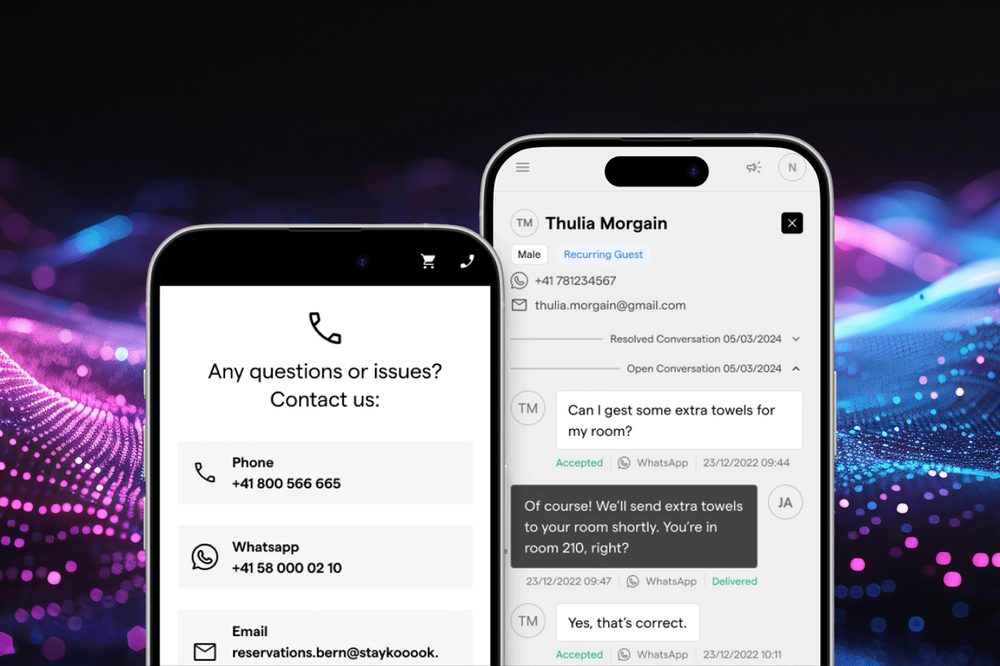
Automation reduces the workload for teams in hotel operations at various levels.
Less repetitive work in day-to-day operationsA large part of daily tasks in hotel operations consists of recurring activities: answering standard enquiries, passing on information, checking data or reconciling it between systems.
Faster and more consistent response times
Automation makes it possible to answer standard enquiries immediately or prepare responses in a structured manner. This shortens response times without requiring additional staff. At the same time, communication remains consistent, regardless of how many enquiries are received simultaneously.
More consistent service quality during peak periods
Error rates can be significantly reduced through automation. For hotel operations, this means: fewer corrections, fewer misunderstandings and more stable processes around the clock – even under high pressure.
Greater focus on personal guest care
The effort required for coordination, monitoring and data entry is reduced. Staff can concentrate more on direct interaction with guests. This has a positive impact on service quality and guest comfort.
Greater output without a proportional increase in staffA key benefit of automation in the hospitality industry is scalability. Whilst the effort involved in manual processes increases with every additional request, automated workflows remain consistent.
Good to know: Studies suggest that automation and AI can boost productivity by around 20–35%. For hotel operations, this means that a rising volume of enquiries or higher occupancy rates do not automatically lead to a proportional increase in workload. Teams remain capable of handling the workload, even as operational complexity increases.
The potential of automation is widely recognised in the hotel industry. Nevertheless, implementation often falls far short of what is possible. This is rarely due to a lack of interest or a reluctance to invest. The causes are mostly structural:
Technological complexity
Many hotels operate with an established system landscape comprising PMS, channel managers, payment providers and various communication solutions. Any additional automation initially appears to be yet another component that needs to be integrated. The effort involved seems considerable, whilst the benefits are difficult to grasp.
Concerns about service quality
Particularly in an industry where hospitality plays a central role, there is a fear that standardised communication or automated processes might come across as impersonal. In practice, this often leads to processes being deliberately kept manual, even though they could be automated.
Fragmented system landscape
In recent years, many hotels have introduced tools to optimise communication or payment processing, for example. In day-to-day operations, however, this creates new disconnects. Systems operate alongside one another rather than with one another, information must be transferred manually, and automation remains limited to individual steps.
Lack of strategic integration
Automation is frequently treated as a technical issue – think ‘technology in the hotel’ – rather than as part of operational management. Without a clear definition of objectives, it remains unclear which processes are actually to be improved and how success is to be measured. Investments are then based more on functions than on concrete impacts in day-to-day operations.
Finally, it is evident in many hotels that, despite the introduction of new technologies, existing working methods remain unchanged. Automation potential is not fully exploited because processes continue to be controlled manually or subject to additional checks. The expected effect fails to materialise, even though the technical prerequisites are in place.
Many of the problems described above have a single root cause: the lack of connection between digital tools. Information exists in silos, processes break down at interfaces, and staff end up acting as the interface between systems.
Integration changes this logic.
When systems communicate with one another and data is consistently available, end-to-end processes emerge. Tasks are no longer handed over but continued. Coordination is reduced because information is already available in the system. Then a payment recorded online is immediately visible in the PMS, and room planning automatically takes account of changed arrival times.
It is only through this interplay that automation comes into its own.
This also shifts the perspective on technology in the hospitality industry – away from individual tools towards platforms that map processes.
The staff shortage in the hotel industry is here to stay, not as a short-term challenge, but as a structural condition.
At the same time, expectations regarding speed, availability and consistency are rising throughout the entire guest journey. This development cannot be addressed by additional resources alone.
The key lever therefore lies in how existing resources are deployed. Automation plays an important role in this context, not as a replacement for staff, but as a structural support working behind the scenes. Where tasks are repetitive, processes interlock and information needs to flow, it can stabilise workflows and reduce complexity.
For this to succeed, however, a shift in perspective is necessary:
Instead of focusing on individual tools and their functions**, the focus** shifts to how processes work end-to-end and how data can be utilised across systems.
Once this foundation is in place, hotel automation delivers on its promises.
Automation in the hotel industry means digitally mapping recurring processes such as guest communication, check-in, payment processes or internal coordination, and carrying them out partially or entirely without manual intervention. The aim is to make operational processes more efficient and to reduce the workload on staff.
Processes with clear workflows and a high repetition rate are particularly well-suited to automation. These include communication before, during and after the stay, booking and quotation processes, check-in and check-out, as well as internal coordination between departments such as reception and housekeeping.
Automated guest communication ensures that information is provided at the right time – for example, before arrival or during the stay. Guests receive quick, consistent responses, whilst the hotel team spends less time on standard enquiries and can focus more on individual concerns.
No, on the contrary. Automation primarily handles repetitive tasks in the background. This leaves more time for personal interactions with guests. Used correctly, automation therefore improves service quality rather than reducing it.
Individual tools usually only automate isolated steps, such as responding to enquiries or digital check-in. Without integration, additional interfaces and manual intermediate steps are created. Only through interconnected systems can end-to-end processes be created that truly reduce operational effort.
The most important step is not to start with tools, but with processes. Hotels should analyse where time is lost in day-to-day operations and which procedures are repetitive. Building on this, they can select systems that support these processes end-to-end and are integrated with one another. This results in genuine process automation rather than isolated, one-off solutions.
 LIKE MAGIC
The guest experience & operations platform is all about modular and interface-open architecture. Its maximum flexibility allows the smooth integration of top-notch solutions: easy and seamless.
Schedule a demo