
Where does AI already deliver tangible added value in hotels today – or, which investment is really worth it?
Hardly any other topic is currently being discussed as fervently in the hotel industry as artificial intelligence.
Yet whilst providers of AI tools promise personalised guest experiences and significant efficiency gains in day-to-day operations, many hotel operators are asking themselves: where does AI already deliver tangible added value in hotels today – or, to put it another way: which investment is really worth it?
This article explores
- the areas in which AI tools are already making workflows more efficient, reducing the workload on staff and improving the guest experience, and
- what conditions are essential for their use to actually have an impact.
What is AI?
Artificial intelligence (AI) refers to a technology that enables computers and machines to perform tasks that normally require human capabilities such as learning, pattern recognition, language comprehension or decision-making.
The term is often used in current discussions in connection with other technological approaches and processes that differ significantly:
Automation
In simple forms of automation in hotels, systems carry out clearly defined processes independently. One example is the automated sending of a booking confirmation or a pre-stay email following a reservation. Such processes follow fixed rules and do not require learning algorithms.
- Machine learning goes one step further. Here, systems learn from existing data and recognise patterns. For example, a system makes predictions about demand, length of stay or price trends.
- Finally, generative AI can create or formulate content itself. This includes, for example, automatically generated suggested replies to guest enquiries or personalised messages throughout the guest journey.
Being able to clearly understand these terms and their meanings is important for realistically assessing the potential of these tools.
AI in hotels – examples of successful implementation
There are several areas of application in the hospitality industry where AI is already delivering tangible added value. This is particularly true where recurring enquiries arise, large volumes of data are processed, or rapid responses are crucial.
Below, we look at some typical areas where artificial intelligence can already be put to good use in hotels today.
Guest communication and service
Communication with guests is one of the most time-consuming tasks in hotel operations. Many enquiries are repetitive: questions about check-in times, parking facilities, breakfast options or room amenities, for example.
AI-powered systems automatically answer such standard enquiries or independently generate suitable response suggestions. In doing so, they draw on existing information such as booking details, stay status or answers to frequently asked questions.
A typical real-world example:
A guest sends a message via WhatsApp: “Is my room ready yet?” The system recognises the enquiry, checks it against the current room status in the PMS and automatically generates a suitable reply.
Benefits
Faster response times
Guests often receive replies within seconds.
Consistent communication
Information is provided uniformly across all channels.
Reduced workload for the front office
Staff spend less time dealing with recurring standard queries.
Improved service quality
The team can focus more on complex issues and personal interaction with guests.
Reducing the front office workload
In many hotels, the front office is the central hub for guest enquiries, organisational processes and internal coordination. At the same time, it handles a particularly high volume of repetitive tasks. These include, for example, answering recurring questions, checking booking details or forwarding enquiries to other departments.
AI tools support staff by partially automating such routine tasks and making relevant information available more quickly. For example, systems can pre-sort incoming enquiries, suggest appropriate responses or consolidate information from various systems.
An example:
Several guests arrive at the same time. Whilst some are at check-in, emails, chat messages and telephone enquiries are coming in simultaneously. An AI-powered system automatically categorises the incoming messages, answers standard questions independently or immediately displays a suitable response template to staff.
Fewer time-consuming routine tasks
Standard enquiries are answered or prepared automatically.
Faster access to information
Staff receive relevant data and suggested replies without having to search for them.
Greater focus on the guest
The team can concentrate more on personal service and more complex issues.
Smoother operations during peak times
Response times remain consistent even with high volumes of enquiries.
Personalisation throughout the guest journey
Guests increasingly expect offers and information tailored to their individual interests, the purpose of their stay or the stage of their journey. That is why personalisation plays a central role in the hotel industry.
AI helps to derive relevant recommendations from existing data. Instead of sending the same offers to all guests, systems identify which additional services might be of particular interest to specific guests – for example, based on previous stays, booking data or typical usage patterns.
A guest has regularly used the spa during previous stays and prefers quiet rooms. Before their arrival, an AI-powered system automatically generates a tailored message, such as a spa offer for the day of arrival or a note regarding available particularly quiet rooms.
More relevant offers
Guests receive information and additional services that match their preferences.
Higher conversion rates
Tailored offers are accepted more frequently than general standard offers.
Better guest experiences
Communication feels more personal and less generic.
More efficient use of existing data
Information from bookings, CRM systems or previous stays is systematically utilised.
Upselling and revenue optimisation
Additional services such as room upgrades, late check-out or spa offers are important sources of revenue in the hotel industry. At the same time, the success of such offers depends heavily on the right timing and the appropriate context. An offer sent at the wrong time or without reference to the booking is often ignored.
AI makes it possible to target upselling offers effectively. To do this, systems analyse factors such as booking details, length of stay or previous preferences. From this, they determine which additional services might be particularly relevant to a guest and when the right moment is to make an offer.
A guest has booked a standard room for two nights and is expected to arrive late in the evening. An AI-powered system recognises that an upgrade to a quieter room or a late check-out could be particularly relevant. It automatically includes the offer in pre-stay communications or during digital check-in – precisely at the moment when the guest is already interacting with the hotel.
Better timing
Offers appear exactly when they are most relevant to guests.
Automated offer management
Staff do not need to manually create or send upselling offers.
Consistent revenue strategy
Offers are systematically placed throughout the guest journey.
Higher revenue
Relevant additional services are booked more frequently.
Operational processes & internal workflows
Many operational processes still require time-consuming manual coordination between departments, such as between the front office, housekeeping or revenue management. This takes time and increases the risk of errors.
AI-powered systems help to analyse information more quickly, automatically identify priorities and present relevant data to staff in a clear and organised manner. In doing so, they increase operational transparency and reduce the need for coordination.
Several guests request an early check-in at the same time. Based on room status, expected departures and housekeeping schedules, the system identifies which rooms are likely to be available first. It automatically forwards this information to the front office, enabling staff to make informed decisions without having to manually check multiple systems.
Benefits:
Less internal coordination
Relevant information is available more quickly and centrally.
Reduced risk of errors
Automatic analyses minimise the risk of incorrect decisions.
Greater operational transparency
Staff can see more quickly which tasks take priority.
More informed management decisions
Data from various processes can be systematically analysed.

What artificial intelligence cannot (yet) do
To realistically assess the potential of AI tools, it is important to understand their (current) limitations.
Artificial intelligence can speed up processes, structure information and automate routine tasks. However, it cannot independently assess every situation or replace complex interpersonal interactions. In the hotel industry in particular, empathy, situational judgement and personal relationships continue to play a central role.
A guest complains at reception about a problem with their room after a long journey. Whilst an AI can provide information or suggest possible solutions, listening, gauging the guest’s mood and finding a suitable solution remain tasks for experienced staff.
AI also reaches its limits when it comes to complex decisions. Systems can analyse data and recognise patterns, but they require clear parameters and high-quality data. Without this foundation, unreliable results can quickly arise.
For hotels, this means that AI should not be seen as a replacement for human service, but as a tool that supports staff. Used correctly, it reduces routine tasks and frees up time for precisely those moments when personal service makes the biggest difference.
Why many AI initiatives in hotels fail
Despite the considerable interest in artificial intelligence, the actual impact on hotel operations often falls short of expectations.
This is primarily due to structural problems:
Lack of a data foundation
AI systems rely on working with structured and consistent data. In many hotels, however, relevant information is stored in different systems: booking data in the PMS, communication histories in messaging tools, preferences in the CRM.
If this data is not linked, no complete picture of the guest journey emerges. AI tools can then only recognise patterns to a limited extent or derive meaningful recommendations.
Isolated tools
Another common problem is the use of individual AI solutions without integration into the existing system landscape.
A messaging tool with AI functionality, a separate upselling system or an analytics tool are useful in their own right.
In day-to-day operations, however, new gaps arise when these systems do not communicate with one another. Information must be transferred manually or is not visible to other departments.
Lack of integration into processes
Even technically sound AI solutions only deliver their full benefits when embedded in clear operational processes. If it is not defined how a system is to be used in day-to-day work or which tasks it actually eliminates, the impact remains limited.
A real-world example:
A hotel introduces an AI-powered response function for guest enquiries. However, staff continue to check every message manually before it is sent. The process remains virtually unchanged and the expected time savings fail to materialise.
Prerequisites for the successful use of AI in hotels
Crucial to the successful use of AI in the hospitality industry is the seamless interplay of data, system integration and clearly defined processes.
Structured and consistent data as a foundation
The more structured and consistent the data is, the better systems can recognise patterns and derive meaningful recommendations.
In hotel operations, this means, for example:
- complete booking data
- consistent guest information
- structured communication histories
- up-to-date status information on rooms, payments or stays
If data is incomplete or stored in isolation across different systems, AI systems can only work with it to a limited extent.
System integration
In addition to data quality, the system landscape plays a key role. Many hotels use different tools for bookings, communication, payments or housekeeping (collectively often referred to as the hotel tech stack). Only when these systems are interconnected can information from various sources be consolidated and analysed automatically.
Without integration, data silos arise. AI can then only access individual areas of information and loses a large part of its potential.
Clear process logic
Another important prerequisite is a clear definition of operational processes. AI can support or automate workflows, but it cannot replace unclear processes.
It is best for those responsible to first define:
- which steps take place along the guest journey,
- which tasks can be automated, and
- which decisions will continue to be made by staff.
Only then can AI be deployed in a targeted manner.
Why the order is crucial
In many cases, companies attempt to introduce AI before these foundations have been laid. This often leads to disappointing results.
The more successful approach usually follows the reverse order:
- Understand and structure processes
- Consolidate data
- Integrate systems
- Deploy AI in a targeted manner
If this sequence is followed, there is a good chance that AI will become an effective tool in day-to-day hotel operations.
From standalone solutions to intelligent orchestration
Many hotels are currently testing individual AI applications, for example for guest communication, upselling or data analysis. Such solutions can improve specific tasks, but are often limited to a single area of application.
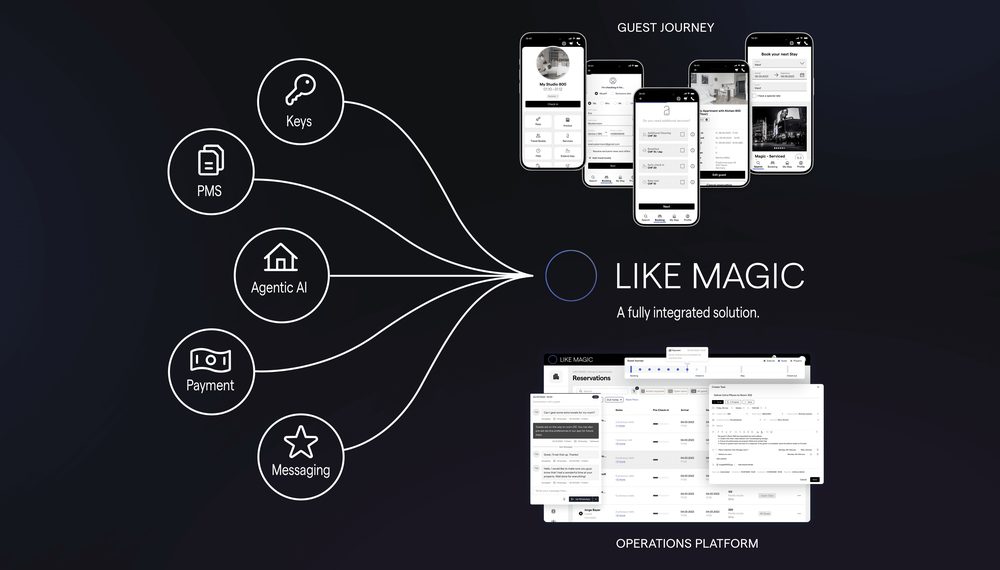
The real added value only emerges when AI is deployed throughout the entire guest journey and different systems work together.
In practice, this means, for example:
- The messaging system knows the current room status.
- Upselling offers take into account length of stay and room category.
- Staff can see communication history, payment status and special requests at a glance.
This requires an overarching structure that brings together information from different systems.
This is where experience layers come into play. These connect existing systems, synchronise status information and consolidate relevant data. This creates a platform logic in which processes can be coordinated throughout the entire guest journey.
The result: a consistent experience for guests. For staff, information becomes more transparent and decision-making easier.
Practical decision-making questions for hoteliers
Many AI solutions appear convincing at first glance. Presentations showcase impressive features, and providers promise efficiency gains or new revenue potential.
However, the true potential can often only be identified by answering a few fundamental questions:
Does the AI solve a specific operational problem?
Not every technological possibility is automatically a sensible application. The key factor is whether a solution addresses a real problem in hotel operations.
Helpful questions in this context include, for example:
- What specific task does the AI perform?
- How much time is currently required for this process?
- Which manual steps could be eliminated as a result?
If an AI application does not bring about a measurable improvement in day-to-day work, its benefits are often limited.
Does the solution fit in with existing processes?
AI works best when it is integrated into existing workflows. If staff have to completely change the way they work or if additional intermediate steps are introduced, a new solution is rarely used in the long term.
Hotels should therefore consider:
- At which stage of the process will the AI be integrated?
- Which tasks will remain with the team?
- How will the workflow change for staff?
Is the necessary data available?
Without a sufficient data set, systems generally only deliver limited results.
It is therefore important to ask:
- What data does the AI use?
- Where is this data currently stored in the system?
- Is it complete and up to date?
Does it actually make day-to-day work easier?
One of the most important questions is often also the simplest: does the new solution really make day-to-day work in the hotel easier?
Technology should not create additional complexity. Ideally, it reduces manual tasks, speeds up processes and frees up more time for personal service.
Asking these questions early on allows you to better assess which AI applications make sense for your own business and which are more experimental in nature.
Conclusion: AI tools are tools, not an end in themselves
Artificial intelligence will increasingly shape hotel operations in the coming years. Even today, there are numerous areas of application where AI tools can speed up processes, reduce the workload on staff and improve the guest experience. Noticeable efficiency gains are achieved particularly where there are many repetitive tasks or large volumes of data need to be analysed.
At the same time, it is clear that the benefits of AI depend less on individual functions than on the structural conditions within the hotel. Without consistent data, integrated systems and clearly defined processes, many applications fall short of their potential.
Hotels wishing to use AI successfully are therefore best advised to start with a fundamental analysis of their operational processes. Only when processes, data and systems work together effectively can artificial intelligence realise its full potential.
In this way, it becomes a tool that supports staff and creates space – for those moments when personal service makes the biggest difference.
Frequently asked questions about AI in hotel operations
What tasks can AI already handle in hotels today?
AI is particularly well suited to repetitive tasks in the hospitality industry. These include, for example, automatically responding to guest enquiries, analysing booking data, providing personalised offers throughout the guest journey, or assisting with operational decisions in the front office. The aim is to reduce the workload on staff and make processes more efficient.
Is artificial intelligence replacing staff in hotels?
No. In the hotel industry, AI is primarily a tool to support staff. It takes on routine tasks, analyses data or provides information more quickly. Personal service, empathy and individual decision-making remain the core responsibilities of the hotel team.
What are the key requirements for the successful use of AI in hotels?
Three prerequisites are essential for AI to actually deliver added value: data must be structured, systems must be interconnected, and processes within the hotel must be clearly defined. Only when these fundamentals are in place can AI tools evaluate information meaningfully and effectively support operational processes.
In which areas does AI bring the greatest benefits in a hotel?
AI delivers particularly significant added value where there are many repetitive tasks or large volumes of data need to be processed. Typical areas of application for AI-based tools include guest services in the hotel, the front office, personalised offers, upselling and the analysis of operational data.
