All articles
Hotel Operations
Where digitalisation in hotels delivers measurable time and cost savings

New PMS systems, chat tools, self-check-in solutions, digital payment processes, upselling modules: the hotel industry has invested heavily in digitalisation in recent years,
Nevertheless, the hoped-for relief in day-to-day operations often fails to materialise: staff continue to switch between systems and enter data multiple times, guests ask the same questions as before, and queues do not disappear but simply shift from the counter to the inbox.
In most cases, these problems stem from a fundamental misunderstanding: digitalisation does not automatically mean efficiency. A tool can map processes digitally without simplifying them and capture information more quickly without reducing the workload. What is crucial is the intelligent automation of entire processes.
In this article, we present 10 specific use cases for digitalisation in the hotel industry. We explore how targeted process automation creates measurable efficiency gains – for management, the front office and revenue – what is required to achieve this, and how to avoid common mistakes when digitalising processes.
We have already addressed a common misconception: an analogue process is often considered digitised simply because a digital tool is used for it.
But a digital representation does not necessarily mean simplification.
Two examples:
The crucial difference lies between the digitisation of individual steps and the automation of entire processes. Only when an intelligent system automatically processes information, distributes tasks within the system and transparently synchronises statuses does the actual workload decrease noticeably.
The following 10 use cases demonstrate the benefits that cross-process and targeted digitalisation can bring to a hotel. They relate to key processes surrounding check-in, communication, data management, payment processes and internal coordination – in other words, precisely those areas where time, resources and revenue potential are tied up on a daily basis.
Scenario
Friday, 6.00 pm. Several guests arrive at the same time. Most have already checked in digitally, provided payment details and specified their arrival time.
Upon entering the hotel, the guest’s status is updated in the system. Rooms are prepared, billing details are on file, and additional requests have been forwarded. Staff at the counter can focus entirely on welcoming guests.
Benefits
Monday morning. Several arrivals are due, whilst housekeeping coordination is taking place in parallel. Various enquiries arrive in the inbox : a question about parking, a booking enquiry for a weekend, a request for an extra pillow.
The system in the background automatically recognises standard enquiries, responds to them in a context-appropriate manner and, where necessary, processes them directly. The rate enquiry generates a personalised booking link showing current availability. The request for an additional service automatically creates a task in the relevant department. Information on check-in times or arrival is displayed in multiple languages and in line with the brand’s guidelines.

A regular guest arrives again. At check-in, the team already knows that he prefers a quiet room, arrives late and booked an upgrade during his last stay. His billing address is on file, special requests are documented and payment preferences are saved.
Benefits:
A guest books a room and receives personalised additional offers before arrival: parking, late check-out, breakfast upgrade. With just a few clicks, they add to their booking and enter their payment details directly online. Upon arrival, all services are already correctly booked, without the need for manual updates or queries regarding the credit card
Arrivals are piling up, the phone is ringing, and messages are coming in via various channels at the same time. At such moments, the team’s resilience is just as crucial as the quality of service.
When an intelligent system takes over routine processes, the dynamics change noticeably. Standard enquiries have already been answered, check-in details recorded in advance, and payments processed.
The key point is this: fewer repetitive tasks mean less stress. Less stress means a lower error rate and a more stable team structure. In times of a tight labour market, this represents a major strategic advantage.
A room becomes available earlier than planned, whilst another requires additional preparation due to a special request. At the same time, a guest announces their arrival an hour earlier.
This information is automatically visible in the system. The changed arrival time updates the prioritisation, housekeeping sees the status in real time, and special requests are recorded directly and visible to all relevant departments.
A new booking is received. The guest adds an extra service, enters payment details and receives a confirmation. All information is immediately available in the connected systems. Changes to the booking status are automatically synchronised, extra services are correctly booked and payment information is consistently managed.
A hotel’s occupancy rate is rising. More bookings are coming in, more arrivals are clustering, and the volume of communication is growing. Nevertheless, the team size remains stable.
This works because the system handles routine processes. It answers standard enquiries, processes check-in data in advance, handles payment transactions and offers additional services.
Advantages
Growth does not result in a proportional increase in workload.Staff costs do not rise in line with the volume of bookings.Operational stability and cost structure improve.
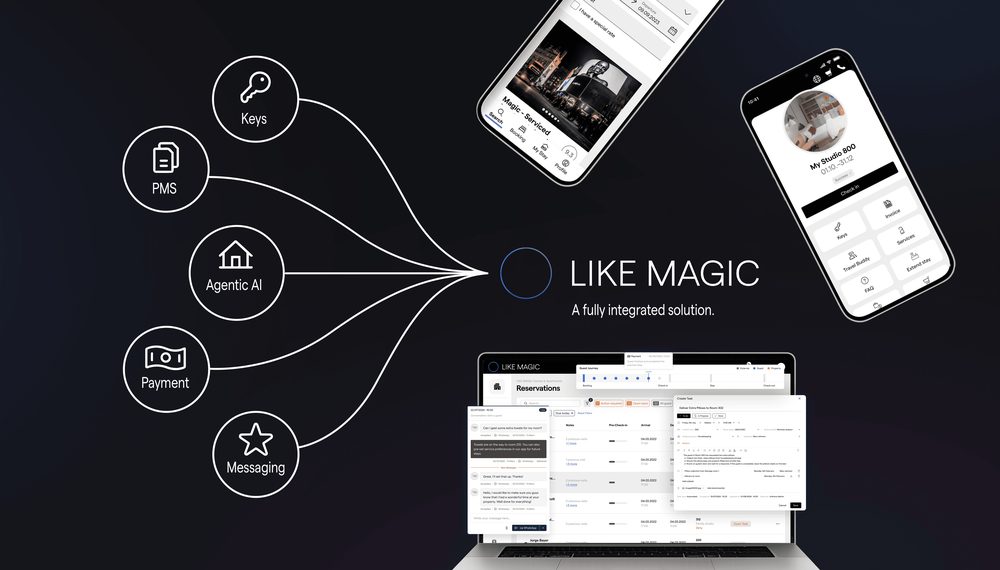
A glance at the dashboard is all it takes: current capacity utilisation, additional revenue, payment status, open items and operational metrics are available in real time. No manually created Excel reports, no data queries from various systems, no delayed analyses. The relevant metrics are generated directly from ongoing processes.
Guests receive immediate responses to enquiries, can easily book additional services and experience smooth processes at check-in and check-out. Misunderstandings occur less frequently, billing errors no longer occur and information is consistent.
For digitalisation to work as described in our use cases, the following requirements must be met above all:
Clear processes
Workflows must be clearly defined. Unclear responsibilities, ad-hoc procedures or informal agreements cannot be meaningfully digitised. Efficiency begins with transparency regarding the existing process and all key issues.
Consistent data
Automation only works if information is recorded in a structured manner and can be utilised by the system. Duplicate entries, conflicting data sources or isolated tools prevent end-to-end workflows.
Integration
Real time savings are only achieved when data flows seamlessly between PMS, communications, payment processing and operational departments.
The order in which things are done also matters: introducing new software first and then trying to adapt processes often creates additional complexity. It makes more sense to start with the desired end state: Which processes should be automated? What data is required for this? Which systems need to work together to achieve this?
Many digitalisation projects fail due to the same mistakes:
Too many individual solutions
Managers introduce a separate tool for every problem. The result is new interfaces, additional logins and more coordination effort rather than less.
Digitalisation without a clear vision
Companies digitise hotel processes simply because it is possible, not because there is a defined efficiency target. The benefits are difficult to measure and remain unclear.
Digitalisation without an understanding of efficiencyA process is mapped digitally, but not simplified. The workload is merely shifted rather than reduced.
New tools, old ways of working
Even after introducing new tools, teams continue to work as before. Opportunities for automation remain untapped.
Lack of accountability for end-to-end processes
No one is responsible for the overall process, which is why gaps arise between departments and systems. Efficiency requires clear accountability across the entire workflow.
Digitalisation offers great potential for the hotel industry, but it is not an end in itself. It is only economically relevant if it measurably saves time, reduces errors and generates additional revenue.
For managing directors, this means, above all, understanding efficiency not as the sum of individual tools, but as a systemic issue. What matters is not how many solutions are in use, but how well they work together and automate entire process chains.
Three measures play a key role in this
It is on this basis that digitalisation delivers its true economic impact, and does so in the long term.
Yes, provided entire processes are automated rather than just individual steps being digitised. Time savings are achieved primarily through fewer manual interventions, less duplication of work and clear workflows.
Smaller establishments in particular benefit from structured processes, as they cannot cope with growth and increasing communication volumes by hiring additional staff. Automation helps to overcome these challenges and work efficiently with existing resources.
Automation takes over repetitive routine tasks. The aim is not to reduce staff numbers, but to lighten the workload. Thanks to this change, teams gain time for personal support, advice and more demanding tasks.
It makes the most sense to start with high-volume processes that have a clear structure, such as check-in, guest communication or payment procedures. To do this, it is first necessary to create transparency regarding existing processes.
It is crucial to integrate systems and work on a shared data platform. Stand-alone solutions often lead to data silos and duplication of effort. Operational efficiency in a hotel is achieved through collaboration, not through a multitude of tools and new technologies alone.
In addition to time savings, key metrics such as reduced queries, lower error rates, higher ancillary revenue and improved reviews are relevant. It is important to define clear targets before implementation in order to accurately measure changes.
 LIKE MAGIC
The guest experience & operations platform is all about modular and interface-open architecture. Its maximum flexibility allows the smooth integration of top-notch solutions: easy and seamless.
Schedule a demo